BTS-mania poised to boost South Korea's economy well into the future
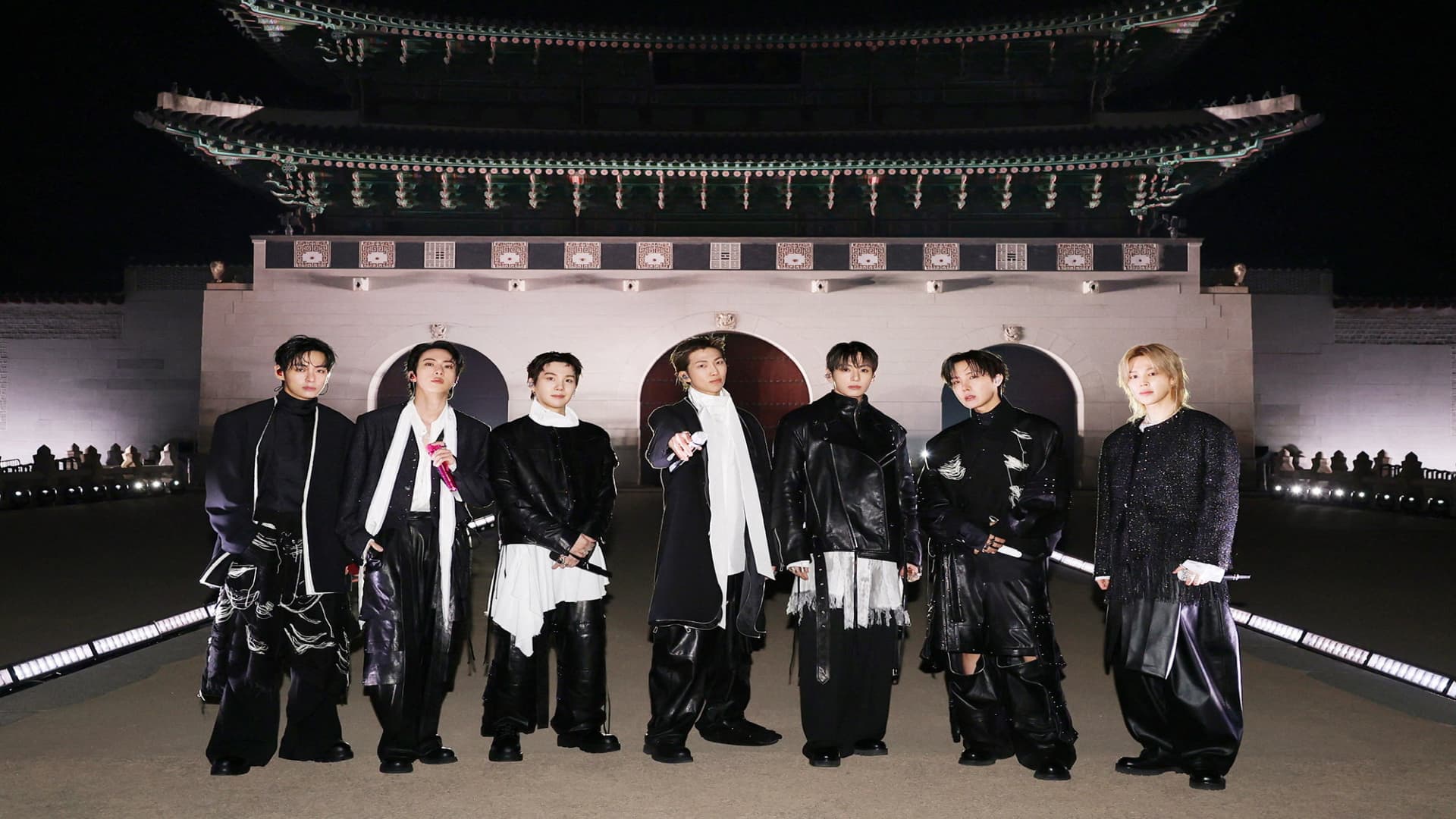
Kpop group BTS pose for photographs upon their arrival for ‘BTS The Comeback Live Arirang’ concert in central Seoul, South Korea, on March 21, 2026.
On Friday, tens of thousands of BTS fans will descend on Busan, South Korea, as the seven-member group stages its second stop in the country as part of their world-spanning Arirang tour.
They will arrive with light sticks, banners and tickets — and money to spend.
Pop culture making an economic impact is not new. The term "Swiftnomics" became shorthand for the impact of Taylor Swift's Eras Tour, which filled hotels, restaurants, and stadiums around the world.
Now, South Korean brokerage NH Securities has a term for BTS: Bangtan-nomics, a portmanteau of "Bangtan," from the group's name in Korean, and "economics."
NH described the fan spending pathway like this: online fandom first becomes streaming, albums and merchandise, before widening into Korean beauty, food, fashion and eventually tourism.
In a May 21 note, the brokerage said 84% of global ARMY — BTS' fanbase — are in their teens and twenties. As they grow older and acquire more spending power, these fans could then come to Korea and contribute to its economy via tourism spending.
In fact, NH predicts that by 2040, BTS fan spending could contribute up to 0.35 percentage points per year to South Korea's GDP.
To put a number to that, 0.35% of South Korea's 2024 nominal GDP is about $6.58 billion, according to CNBC's calculations.
Some early numbers for "Bangtan-nomics" are promising. South Korean media, citing government data, said fans who came for the first BTS concert in April were likely to stay longer and spend more than tourists who did not come for a concert.
This is supported by a 2019 paper by Pyun Ju Hyun, professor of international business and economics at Korea University. Pyun found that BTS concerts held in South Korea attracted many foreign tourists, generating additional spending in the country.
Pyun's paper, sent to CNBC, surveyed foreign concert attendees in Seoul, and found that 98% said they planned to revisit Seoul within the next five years. Two-thirds said they planned to revisit Seoul five or more times within the next five years.
For the concerts in Busan, demand for accommodation spiked so much that the city's government had to step in to curb price gouging among merchants and open up more venues to house the massive influx of fans.